



Sodium Channel
Na channels; Na+ channels
Sodium channels are integral membrane proteins that form ion channels, conducting sodium ions (Na+) through a cell's plasma membrane. They are classified according to the trigger that opens the channel for such ions, i.e. either a voltage-change (Voltage-gated, voltage-sensitive, or voltage-dependent sodium channel also called VGSCs or Nav channel) or a binding of a substance (a ligand) to the channel (ligand-gated sodium channels). In excitable cells such as neurons, myocytes, and certain types of glia, sodium channels are responsible for the rising phase of action potentials. Voltage-gated Na+ channels can exist in any of three distinct states: deactivated (closed), activated (open), or inactivated (closed). Ligand-gated sodium channels are activated by binding of a ligand instead of a change in membrane potential.
Sodium Channel Isoform Specific Products
-
Sodium Channel
(627)
View all products
-
Nav1.1
(11)
View all products
-
Nav1.2
(16)
View all products
-
Nav1.3
(14)
View all products
-
Nav1.4
(14)
View all products
-
Nav1.5
(21)
View all products
-
Nav1.6
(12)
View all products
-
Nav1.7
(61)
View all products
-
Nav1.8
(41)
View all products
-
Nav1.9
(2)
View all products
All Product Categories
-
Sodium Channel Inhibitors
(619)
View all products
-
Sodium Channel Agonists
(10)
View all products
-
Sodium Channel Antagonists
(30)
View all products
-
Sodium Channel Activators
(35)
View all products
-
Sodium Channel Modulators
(28)
View all products
-
Sodium Channel Controls
(5)
View all products
-
Sodium Channel Ligands
(3)
View all products
-
Sodium Channel Related Products (800)
Related Products (800)

-
Antibodies (9)
-
Related Compound Screening Libraries (1)
-
Sodium Channel Isoform Comparison
-
Sodium Channel inhibitor 5
 0 ImagesCat. No.: HY-163637Sodium Channel inhibitor 5 (compound 7d) is a potent inhibitor of sodium channel, with the IC50 of 2.7 μM. Sodium Channel inhibitor 5 plays an important role in antiarrhythmic research.
-
BGC-201259
 0 ImagesCat. No.: HY-107047CAS No.: 444667-97-4Synonyms: RS-1259BGC-201259 (RS-1259) is an orally active inhibitor that simultaneously targets acetylcholinesterase (AChE) (IC50 = 101 nM) and serotonin transporter (SERT) (IC50 = 42 nM). BGC-201259 inhibits 5-HT receptor with an IC50 of 90 nM. BGC-201259 exhibits strong weak activity against the NA transporter (IC50 = 7.7 μM), L-type calcium channel (IC50 = 3.6 μM), σ receptor (IC50 = 2 μM), and sodium channel (IC50 = 5.1 μM). BGC-201259 demonstrates synergistic potential in improving cognitive and emotional symptoms by balancing the inhibition of these two targets. BGC-201259 can be used in research on Alzheimer's disease.
-
Nav1.2-IN-1
 0 ImagesCat. No.: HY-176065CAS No.: 3084825-09-9Nav1.2-IN-1 (compound 5i), a 3-(1,2,3,6-tetrahydropyridine)-4-azaindole derivative, is a potent and selective Nav1.2 inhibitor. Nav1.2-IN-1 induces a reduction in the peak amplitude of Nav1.2 currents with an IC50 value of 7.79 μM. Nav1.2-IN-1 exhibits antiepileptic activity. Nav1.2-IN-1 shows high anticonvulsant effect and low neurotoxicity in subcutaneous Pentetrazole (sc-PTZ)-induced epilepsy mode.
-
Multi-target kinase-IN-6
 0 ImagesCat. No.: HY-178344Multi-target kinase-IN-6 is a Multiple target kinase inhibitor. Multi-target kinase-IN-6 can inhibit cardiac RyR2- and NaV1.5-channels but stimulate SERCA2a pump activity. Multi-target kinase-IN-6 can be used for the research of cardiovascular disease, such as heart failure.
-
711389-S hydrochloride
 0 ImagesCat. No.: HY-19004CAS No.: 94899-83-9711389-S hydrochloride is an antiarrhythmic compound that demonstrates its antiarrhythmic activity by increasing the ventricular fibrillation threshold (VFT). 711389-S hydrochloride also has strong anti-fibrillation effects and safety, and can be used in the study of ventricular fibrillation and sudden cardiac death. 711389-S hydrochloride also inhibits the sodium current.

-
Methocarbamol-13C,d3
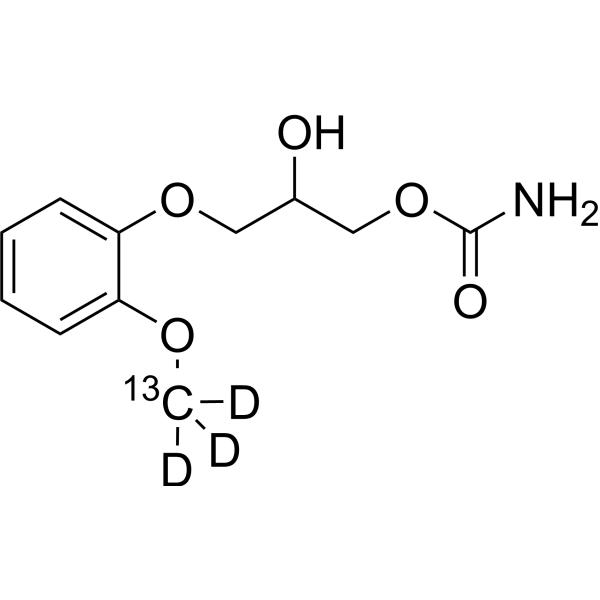 0 ImagesCat. No.: HY-B0262S2CAS No.: 2747917-88-8Methocarbamol-13C,d3 is the 13C- and deuterium labeled Methocarbamol. Methocarbamol is an orally active central muscle relaxant and blocks muscular Nav1.4 channel. Methocarbamol reversibly affects voltage dependence of inactivation of Nav1.4 channel. Methocarbamol has the potential for muscle spasms and pain syndromes research.
-
Nav1.8-IN-8
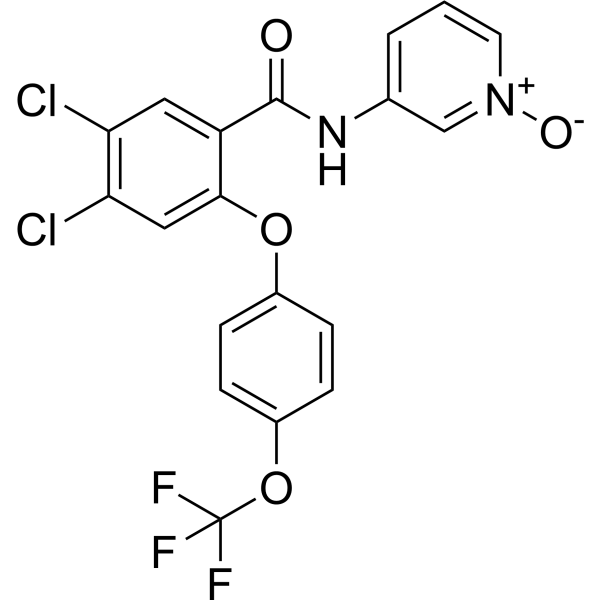 0 ImagesCat. No.: HY-160589CAS No.: 2626945-23-9Nav1.8-IN-8 (Compound A11) is a Nav1.8 channel inhibitor. Nav1.8-IN-8 may prevent associated diseases mediated by sodium ion channels (NaV).

-
RH 3421
 0 ImagesCat. No.: HY-119141CAS No.: 99832-61-8RH 3421, an insecticidal dihydropyrazole, acts as an inhibitor of sodium channel-specific sodium uptake, blocking the uptake stimulated by Veratridine (HY-N6691), Vatrachotoxin (HY-12549), crude scorpion.
-
PF-06678419
 0 ImagesCat. No.: HY-124661CAS No.: 2055468-48-7PF-06678419 is a sodium-coupled citrate transporter and sodium-dependent dicarboxylate transporter inhibitor. PF-06678419 inhibits citrate uptake by interacting with residues near and outside NaCT’s citrate binding site. PF-06678419 can be used for the research of type 2 diabetes mellitus.
-
Onzotrigine
 0 ImagesCat. No.: HY-186303CAS No.: 2834099-10-2Synonyms: LTG-001Onzotrigine (LTG-001) is a potent, selective, voltage-gated sodium channel Nav1.8 inhibitor. Onzotrigine may be used in pain-related research.
-
Nafimidone
 0 ImagesCat. No.: HY-165514CAS No.: 64212-22-2Nafimidone is a stable and brain-penetrant antiepileptic compound Nafimidone shows effective anticonvulsant effects in kindled amygdaloid seizure model. However, The effective window of Nafimidone is narrow, and has obvious epileptogenic effects at high doses. Nafimidone can be used for the study of epilepsy.
-
(R)-Duloxetine
 0 ImagesCat. No.: HY-B0161CCAS No.: 116539-60-7Synonyms: (R)-LY248686(R)-Duloxetine is a isomer of Duloxetine (HY-B0161) that causes tonic and usage-dependent impairment of neuronal Na+ channels. (R)-Duloxetine can be used in pain research.
-
Diphenidol hydrochloride (Standard)
 0 ImagesDiphenidol (hydrochloride) (Standard) is the analytical standard of Diphenidol (hydrochloride). This product is intended for research and analytical applications. Diphenidol hydrochloride (Difenidol hydrochloride) is a non-selective muscarinic M1-M4 receptor antagonist, has anti-arrhythmic activity. Diphenidol hydrochloride is also a potent non-specific blocker of voltage-gated ion channels (Na+, K+, and Ca2+) in neuronal cells. Diphenidol hydrochloride can be used in the study of antivertigo and antinausea[4].
-
Anti-SLC34A2 (Lifastuzumab)-McMMAF
 0 ImagesCat. No.: HY-171737Anti-SLC34A2 (Lifastuzumab)-McMMAF is an antibody-drug conjugate (ADC) consisting of the humanized anti-SLC34A2 (sodium-dependent phosphate transporter 2) antibody Lifastuzumab (HY-P99970) conjugated to the protective group maleimidocaproyl and the tubulin inhibitor MMAF (HY-15579). The ADC toxic molecule and linker part McMMAF (HY-15578). Anti-SLC34A2 (Lifastuzumab)-McMMAF induces apoptosis and can be used in cancer research.
-
AN-132 phosphate
 0 ImagesCat. No.: HY-106819ACAS No.: 105668-70-0AN-132 phosphate is an antiarrhythmic agent. AN-132 phosphate can inhibit Sodium Channel. AN-132 phosphate can prolong atrioventricular conduction time, decrease sinus rate and reduce the force of papillary muscle contraction. AN-132 phosphate can be used for the research of cardiovascular disease.
-
Pilsicainide
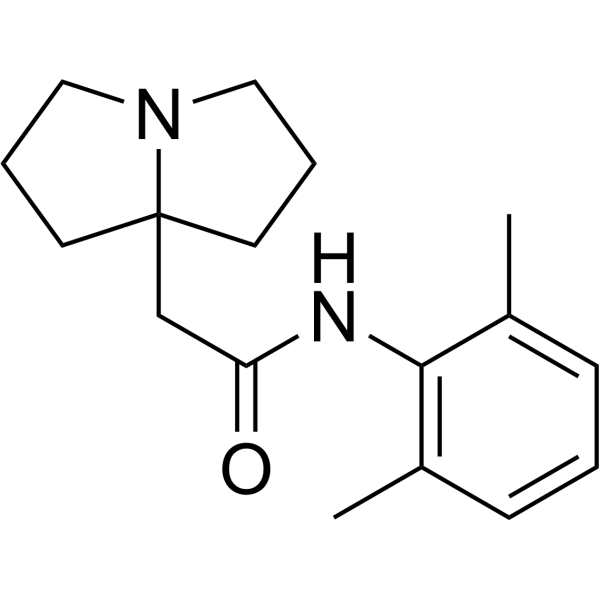 0 ImagesCat. No.: HY-133715CAS No.: 88069-67-4Synonyms: SUN 1165 free base; PilzicainidePilsicainide (SUN 1165 free acid) is a potent sodium channel blocker and potent class Ic antiarrhythmic agent.
-
Nav1.8-IN-24
 0 ImagesCat. No.: HY-183709Nav1.8-IN-24 is a voltage-gated sodium channel Nav1.8 inhibitor with pIC50 values of 7.4 (resting state) and 7.5 (inactivated state), and it exhibits high selectivity for NaV1.1-1.7 subtypes. Nav1.8-IN-24 possesses in vitro safety and drug interaction profiles. Nav1.8-IN-24 can be used for the research of acute pain and chronic neuropathic pain.
-
Benzamil
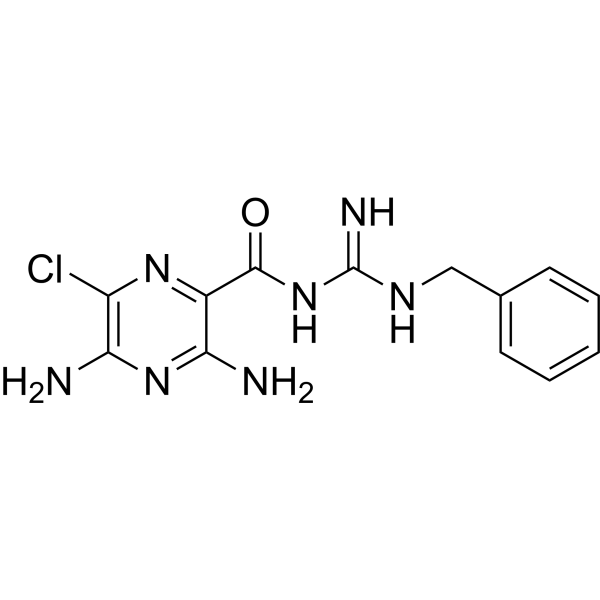 0 ImagesBenzamil (Benzylamiloride), an Amiloride analogue, is a Na+/Ca2+ exchanger (NCX) inhibitor (IC50~100 nM). Benzamil also is a non-selective Deg/epithelial sodium channels (ENaC) blocker, and can potentiate myogenic vasoconstriction. Benzamil inhibits TRPP3-mediated Ca2+-activated currents, with an IC50 of 1.1 μM.




